
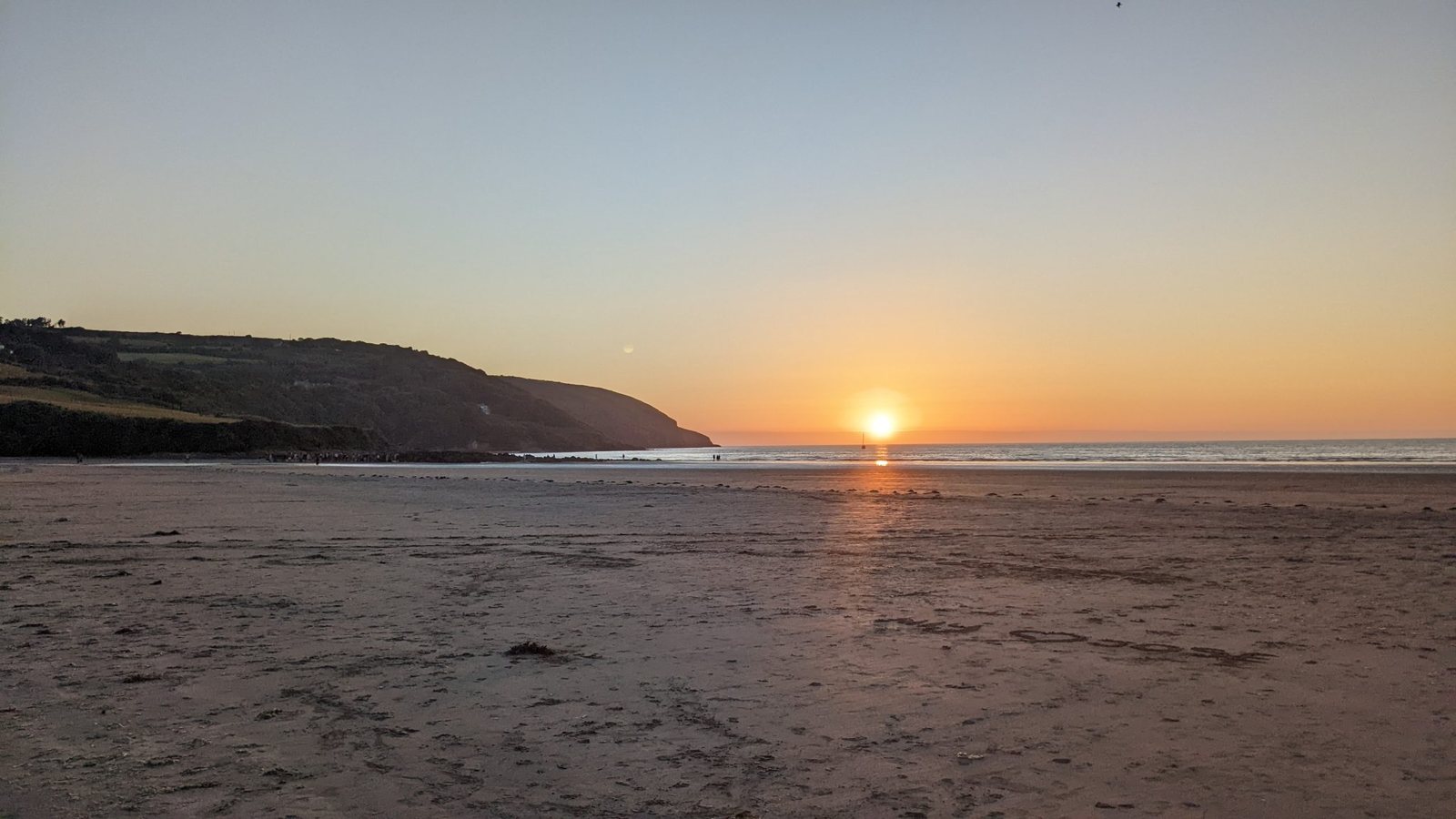
We are often asked when the best time to visit Barmouth is, and we always give the honest answer: it depends what you want. But if you push us, we will admit a soft spot for November. Not the November of the brochures, because there is no such thing, but the real one: short days, big skies, weather arriving off Cardigan Bay every few hours, and a beach so empty you can walk for an hour and count the other footprints. This is the story of one such weekend, told as it happened, and an argument for why the off-season might be the best season of all.
Friday: arriving in the dark
The sun sets at around a quarter past four in mid-November on this coast, so most guests arrive after dark, and there is something to be said for it. The town looks different at night in winter: the promenade lamps, the harbour lights reflecting in still water on a calm evening, a handful of windows lit up the hillside. We walked down to the harbour wall after unpacking. The tide was rising, the air was 8 C and smelt of salt and woodsmoke, and the only sound was the gentle knock of moored boats. In August this same spot has a queue for ice cream. In winter there is nothing you have to do, which is not the same as nothing to do.
Saturday morning: the empty beach
We woke to a sky the colour of wet slate and a forecast promising a front by lunchtime. Low water was at ten, so we went out early with the intention of walking the sands north towards Llanaber and back, roughly 3 miles (5 km) at a saunter. In summer this is a busy stretch; in November it belonged to us, three dog walkers and several thousand oystercatchers. The sand at low water in winter is firm and dark and ribbed by the last tide, and the pools reflect whatever the sky is doing, which on this morning was a great deal.
The light is the reason to come. Winter storms here rarely arrive as a wall; they come in bands, with clear gaps between them, and in those gaps the sun gets under the cloud and lights the estuary from the side. For twenty minutes the far shore at Fairbourne glowed like copper while Cadair Idris stayed buried in cloud, and Barmouth Bridge stood out black against the water. Then the band closed and it rained. Nobody who visits in November should expect to stay dry; the aim is to be warm while wet.
The fish and chips question
Every visitor asks it, usually within an hour of arriving, and every host has an opinion. Barmouth has several places to eat fish and chips, and we are not going to tell you which to choose, partly because it would be unfair and partly because it changes. What we will say is this: in November, the question is not where but whether they are open. Several places drop to reduced days or close altogether from the end of October until the spring, and the ones that stay open shorten their hours. Ask on the day rather than planning around it. We ate ours on the harbour wall on Saturday at one o’clock in a brief window of sunshine, watching a curlew work the mud, and it was, without question, better than the same meal in July with a hundred people and the gulls circling.
The other November discovery is the warm pub in the middle of the afternoon. Take a book. Dry your socks. Nobody will mind.
Saturday afternoon: a wet walk to Panorama Walk
The front had cleared by two, leaving a blustery, showery afternoon and about two hours of usable light, which is exactly enough for Panorama Walk. This is a Victorian viewpoint path on the hillside above the town, laid out in the nineteenth century when Barmouth was being sold to the visiting public as a place of sublime prospects. The route from the centre climbs through the old town lanes and up a minor road for about a mile (1.6 km), gaining roughly 150 m, before a signed path leads to a rocky viewpoint above the estuary.
In summer the view is famous and the bench is occupied. In November we had it to ourselves and the view was, if anything, better: the whole estuary in one sweep, the bridge, the sandbanks exposed by the falling tide, the Mawddach curling inland towards Dolgellau, and squalls marching down the valley one after another. We got soaked on the way up and dried out on the way down, the usual November arrangement. Total time from door to door: about two hours, including ten minutes of standing at the top saying very little.
Sunday: the estuary in storm light
Sunday brought the real weather, a deep low with gusts pushing 50 mph (80 km/h) on the exposed promenade. We did not go far. We did not need to. We walked the length of the seafront with our hoods up and our heads down, watched the spray come over the harbour wall on the flooding tide, and then stood at the bridge end and watched the estuary turn white. Weather like this is why the bridge footway sometimes closes; we did not attempt it. Afterwards there was tea, then the slow business of reading by a window while the rain came sideways, and then, at about half past three, the cloud tore open in the west and the low sun came under it and set fire to the whole of the bay for a quarter of an hour. In November on this coast that happens most weekends.
Why the off-season may be the best season
A few practical realities make the case as well as the romance does. Accommodation is easier to find and generally cheaper from November to March, though a good deal of the town closes and you should check what is open before you rely on it. The beach, the trail and the hills are empty. The birdlife is at its winter peak, with wigeon, teal and huge flocks of waders on the estuary. Sunrise at half past seven and sunset before half past four mean you see both without effort. The sea is still around 11 C to 12 C in early November, which is warmer than April, if you are that way inclined. And there is a kind of honesty to the place out of season that you cannot buy in August: the town is simply itself, going about its business, and you are quietly welcome to join in.
Bring waterproofs, a warm hat, a spare pair of everything and no fixed plans. Check the tide table and the forecast each morning, and let them decide the day. Then go and stand on the beach, alone, and watch the light do what it does here between storms. You may find, as we did, that you never want to come in summer again.