
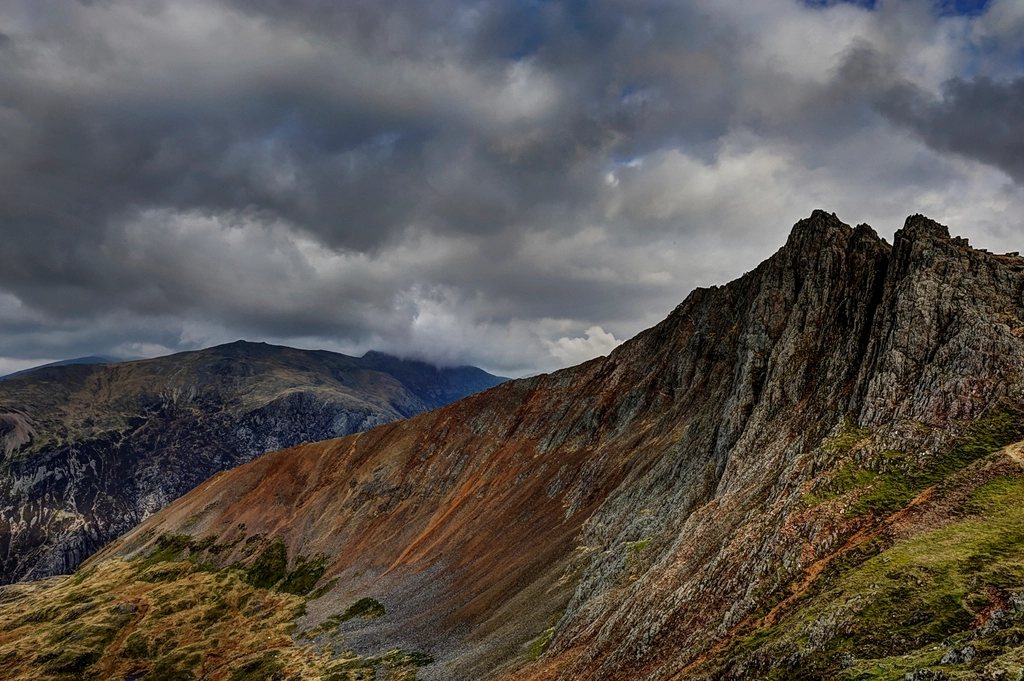
Cadair Idris dominates the view from Barmouth in a way that no other mountain in Wales quite manages. It sits directly across the estuary, its long northern escarpment catching the evening sun, and after a few days of looking at it most of our guests want to stand on top. There are three main routes up, and the Minffordd Path from the southern side is the one we recommend to anyone with hill experience and a full day to spare. It is the steepest and the most dramatic, it passes the finest mountain lake in the range, and it delivers you to the 893 m summit of Penygadair by a ridge that feels much bigger than its height suggests.
Getting to Minffordd from Barmouth
Minffordd is a scattering of houses at the junction of the A487 and the B4405, on the far side of the mountain from Barmouth. By road it is about 20 miles (32 km): follow the estuary to Dolgellau, then the A487 south over the pass at Cross Foxes and down into the head of the Dysynni valley, a drive of roughly 40 to 45 minutes. The car park at the foot of the path fills early in summer and on any dry weekend, so aim to be walking by nine. Without a car, take the bus to Dolgellau and then a service along the A487 towards Machynlleth, which stops close to the path start; check times carefully, because the return options in the late afternoon are limited and you do not want to be racing the last bus off a mountain.
The first hour: steps through the gorge
The path leaves the valley floor at around 90 m above sea level and wastes no time. A flight of several hundred stone steps climbs through sessile oak woodland beside the Nant Cadair, which drops in a series of falls on your left. This is the hardest sustained effort of the day and it is worth settling into a slow rhythm rather than attacking it. After about 40 minutes the trees thin, the gradient eases, and the path bends left into the open cwm with the crags of Craig Cau rising ahead. The National Nature Reserve here is one of the finest in Wales for arctic-alpine plants, and in June the ledges are dotted with roseroot and purple saxifrage for those who know where to look.
Llyn Cau and the choice of routes
Llyn Cau lies at about 470 m, cupped in a near-perfect glacial cirque, and the first sight of it stops most people in their tracks. The lake is dark, cold and deep, backed by a 300 m wall of cliff. A short detour of five minutes takes you to its shore, and this is the obvious lunch spot if the weather is unsettled, because it is also the last easy place to turn round. Many walkers come this far and no further, and it is a perfectly good day out at roughly 3 miles (5 km) return with 400 m of ascent.
To continue, the main path climbs steeply up the left-hand side of the cwm onto the rim. The Minffordd route is usually walked as a horseshoe: up over Craig Cwm Amarch to Penygadair, then east along the ridge to Mynydd Moel and down its southern flank back to the lake outflow. Doing it this way round puts the steepest ground behind you while your legs are fresh and gives you the summit as a mid-point rather than an end.
The rim to Penygadair
The climb onto Craig Cwm Amarch, at 791 m, is the technical crux of the day, though technical is a relative term: there is no scrambling required, just a steep, eroded path with big steps and loose stones, and a few sections where the drop to the lake on your right demands a clear head in wind. From the top the ridge curves round the head of the cwm for about 0.8 miles (1.3 km) with Llyn Cau far below, then rises over broken rock to the summit of Penygadair. A stone trig point and a small stone shelter hut mark the top. On a clear day the view takes in the whole sweep of Cardigan Bay from the Llyn Peninsula to Pembrokeshire, the Mawddach estuary and Barmouth Bridge laid out like a map, and, to the north, the peaks of Eryri with Snowdon itself visible on the horizon.
The full horseshoe measures about 6 miles (10 km) with around 950 m of total ascent. Fit walkers manage it in four and a half hours; a comfortable day with stops is five and a half to six. It is graded as a strenuous mountain walk and should be treated as one. The descent from Mynydd Moel, at 863 m, is long, rough and hard on the knees, and it is where most slips happen.
Weather, turnarounds and honest limits
Cadair Idris makes its own weather. A clear morning in Barmouth can mean cloud sitting at 600 m on the mountain, and the summit is in mist for well over half of the days in the year. The lake is the natural turnaround; the rim is the second. If cloud drops below the top of Craig Cau while you are climbing, if wind on the rim is strong enough to make you stagger, or if the forecast mentions gusts above 40 mph (65 km/h) at summit level, go down. Navigation on the plateau between Penygadair and Mynydd Moel is straightforward in clear conditions but genuinely confusing in cloud, with cliffs on the northern side that do not forgive a wrong bearing. Carry a map and compass and know how to use them. Waterproofs, a warm layer even in August, and at least a litre of water each are non-negotiable. In winter the rim holds snow and ice from December to March and the route becomes a different, more serious undertaking.
- Start early: the steps are cooler and the car park is emptier before nine
- Check a mountain-specific forecast, not the Barmouth seaside one
- Decide your turnaround points before you leave and honour them
- Tell someone your route and expected return time
The chair and the legend
The name means the chair of Idris, and the chair is the great hollow of Llyn Cau seen from the ridge, a seat fit for a giant. Idris himself appears in early Welsh tradition as a giant, a warrior and an astronomer who studied the stars from his mountain throne. The story every walker hears is that anyone who spends a night alone on the summit will wake either a poet or a madman, or will not wake at all. The shelter hut gets a steady trickle of people testing the theory each summer. We have never tried it, and we notice that the ones who do come down looking mostly cold and slightly disappointed rather than transformed. Better, we think, to spend the night in Barmouth, and to look across at the mountain the next evening knowing exactly where you stood.