
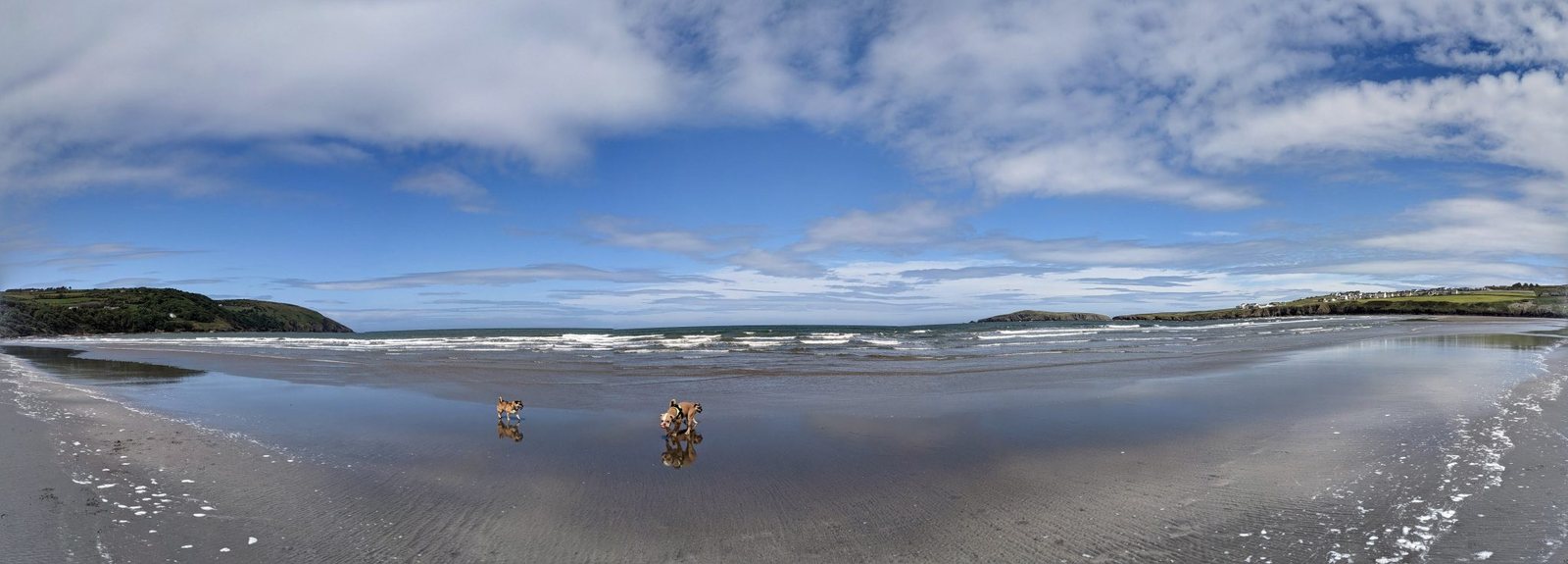
Barmouth beach is not one beach but several, and which one you get depends entirely on the time you arrive. At high water on a big spring tide it is a strip of soft sand backed by the promenade, with waves lapping the sea wall at the harbour end. Six hours later it is a plain of ribbed sand the best part of half a mile wide, threaded with pools and channels, and the estuary mouth to the south has turned into a maze of banks and fast water. We have seen visitors arrive with a picnic at midday, find the sea a distant rumour, and leave disappointed. A little tide knowledge fixes that, and it also keeps you safe.
How the tide behaves here
Cardigan Bay has two high tides and two low tides in every 24 hours and 50 minutes, so each day the times shift roughly 50 minutes later than the day before. High water at Barmouth follows high water at the standard port of Milford Haven by a little over an hour, and most printed tables give Barmouth times directly. The tidal range is significant: on spring tides, which arrive a day or two after the new and full moon, the water rises and falls by 4 m to 5 m, while neap tides at the quarter moons manage only 2 m to 3 m.
That range is why the beach changes so dramatically. A 5 m vertical difference on a beach with a gentle gradient translates into hundreds of metres of horizontal movement. Spring tides also produce the strongest currents, particularly in the estuary mouth where the entire Mawddach empties and fills through a gap only a few hundred metres wide.
Reading a tide table without getting caught out
A tide table gives you the time of each high and low water and its height in metres above chart datum, which is roughly the lowest level the sea normally reaches. Three details trip people up. First, many tables are printed in Greenwich Mean Time all year, so between late March and late October you must add one hour for British Summer Time. Second, the height matters as much as the time: a 4.9 m high water will reach the promenade steps, while a 3.6 m high water will stop well short. Third, the sea does not sit still at low water. It turns within twenty minutes and can rise 1 m in the first hour of a spring flood.
The simple rule we give guests is this: note the time of low water, and treat the two hours after it as the period when the beach is at its biggest and safest for walking, and the three hours before high water as the period when channels behind sandbanks fill fastest.
The sandbanks and the estuary mouth
South of the harbour, where the Mawddach meets the sea, a bar of sand builds and shifts across the entrance. At low water you can walk out towards the tip of the spit and look across to Fairbourne, and the temptation to keep going is strong. Do not. The channel between Barmouth and the Fairbourne side carries the whole estuary’s outflow, runs at several knots on the ebb, and is cold and deep even when the surrounding sand looks innocent. People have needed rescuing here, which is why the town has kept a lifeboat station for well over a century.
Further along the main beach, in front of the town and towards Llanaber, the banks are gentler but the same principle applies. A bank that looks attached to the shore at low water can become an island with a chest-deep channel behind it within an hour of the flood starting. Keep the shore on one side of you, and if you find yourself walking through water to get back, you have already left it too late.
Safe windows for swimming and paddling
The kindest time to swim at Barmouth is the hour either side of high water on the main beach, north of the harbour and well clear of the estuary mouth. The water is deepest, the currents weakest, and the walk from towel to sea shortest. Mid-tide on the flood is also reasonable for paddling and bodyboarding, though the shore break can be lively when a westerly swell is running. Avoid the ebb near the harbour entirely, and be cautious in the last two hours before low water anywhere, when longshore currents pick up and rip channels form between banks.
Sea temperature is another honest constraint. It bottoms out around 7 C to 8 C in March, reaches 15 C to 17 C in August and September, and is still a tolerable 12 C in early November for those who like that sort of thing. Late summer, not high summer, is the warmest swimming. Whatever the month, a swim in a moderate onshore wind is a different animal from a swim on a calm morning, so check the forecast as carefully as the table. In the busiest weeks of summer there is normally a seasonal lifeguard presence on the town beach; swim between the flags when they are up, and swim with someone at all other times.
Why the beach keeps changing shape
Barmouth sits at the point where longshore drift running north along Cardigan Bay collides with the outflow of the Mawddach. Sand moves constantly: north along the beach in a prevailing south-westerly, out to the bar on the ebb, back onto the beach in calm summers. A single winter storm can strip a metre of sand from the promenade end and dump it on the spit, and a couple of quiet months can put it back. The dune line changes, the pools at low water move, and the shortest route from the promenade to the sea in July is not the shortest route in January. Locals talk about the beach the way farmers talk about fields, and they are right to.
Dogs, seasons and a few practical notes
Dogs are welcome on most of Barmouth’s sands all year, but the main section of beach in front of the promenade carries a seasonal restriction through the summer months, typically from the start of May to the end of September, with signs marking where it begins and ends. Outside those dates and outside that zone your dog can run free, and the low-water expanse in winter is one of the best dog walks in Wales. Keep them out of the estuary channel for the same reasons you keep out yourself.
A few last things we tell every guest. Take a photo of the tide table on the harbour noticeboard or the promenade so you have it in your pocket. Aim for a falling tide in the morning if you want a big beach for a family day, and a rising tide in the late afternoon if you want the sea close for a swim before dinner. And if the fog rolls in, which it does on still days in spring and autumn, head for the promenade and let the sand wait: it will still be there, though probably not in the same place, tomorrow.